
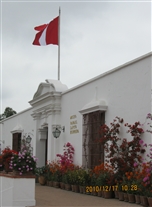
IMG_0854A.jpg
Larco Museum -- Lima Peru
This is the Rafael Larco Herrera Archeological Museum in Lima -- usually known as the Larco Museum.
My memory (and understanding) is that it is a privately-owned museum and mostly displays objects collected by the museum's founder. I think the time most of the collecting was done might have been the 1920s. The dates for the objects in the collection itself were (if I remember correctly) were from between years 1 and 1540, with 1540 being about the time of the conquest by Spain. I seem to recall a lot of stuff was only approximately dated, with the year 1000 appearing a lot (which might have indicated some kind of guess).
Shutter Speed : 1/809
Date Time : 2010:12:17 10:28:29
Equip Model : Canon PowerShot A495
ISO Speed : ISO-100
Focal Length : 12.05
Exposure Time : 0
Aperture : F/6.3

IMG_0859.jpg
Larco Museum -- Lima Peru
These are pottery jugs. In this particular design, the "double spout" (double for part of its length) serves as a handle. There were MANY pottery jugs and bottles of many different types.
What puzzled me was the great condition of this very old jugs (in addition to the excellent craftsmanship for much of it). Many looked like they had never been used. I later came to an "understanding" (I THINK I understand): they had indeed never been used, except once, in a burial ceremony. These were manufactured to be used in such ceremonies, and then buried with the deceased person's body. At least, I think that was what was going on.
As I said there were many different styles of pottery. I had the impression a lot of the dating was by style, since a lot of this stuff was collected (dug up) before scientific means were available to determine age from samples of the surrounding soil, or from organic material buried at the same time as the pottery.
Shutter Speed : 1/25.28
Date Time : 2010:12:17 10:44:02
Equip Model : Canon PowerShot A495
ISO Speed : ISO-400
Focal Length : 12.05
Exposure Time : 0.04
Aperture : F/4
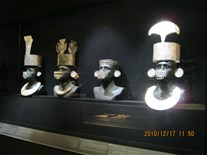
IMG_0863.jpg
Larco Museum -- Lima Peru
There was also a signifigant amount of gold and silver. There are earrings and various other types of headdresses.
Shutter Speed : 1/12.91
Date Time : 2010:12:17 11:50:37
Equip Model : Canon PowerShot A495
ISO Speed : ISO-800
Focal Length : 6.6
Exposure Time : 0.08
Aperture : F/2.99

IMG_0864.jpg
Larco Museum -- Lima Peru
This is a quite interesting thing I don't recall seeing at any other museum. In addition to the "best" pieces carefully displayed in lighted glass display cases, they also allowed visitors to go thru their "back room" storehouse. Here thay had pieces that (I'm guessing" were of lower quality or poorer condition than the on-display pieces. However, these rooms provide some idea of the number of pieces in the museum's collection (the quantity they have in addition to the quality).
The pieces in these rooms have been arranged and are stored by type of object. They have maybe 5 rooms with rows of "library"-type shelving in each room (the room is full of shelving; it's not just shelves on the walls of the rooms. I'm guessing what's shown in this photo is perhaps 1% of what they had in those storage rooms.
These pieces are, of course, "on display"too. However, they are not as carefully lighted and arranged as in the main museum. Also, I believe there were only tiny labels and perhaps an occasional 3 x 5 card describing (in Spanish) what these items are, with maybe one label or card descirbing the (similar) type of things on perhaps 4 or 5 shelves.
Shutter Speed : 1/30.06
Date Time : 2010:12:17 11:55:21
Equip Model : Canon PowerShot A495
ISO Speed : ISO-400
Focal Length : 6.6
Exposure Time : 0.03
Aperture : F/2.99

IMG_0857A.jpg
Larco Museum -- Lima Peru
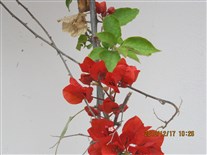
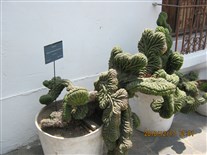
The museum had a nicely landscaped courtyard, with several different kinds of plants growing in it.
In this area, there was a separate-entrance display with what might be called X-rated designs on the pottery. In some cases, the handles of pots were human (and sometimes animal) figures dioing various things that I'll just let the reader imagine (you can imagine some of the spout designs too).
It's not known exactly what was going on with these pots. What some cultures consider pornography could (in those cultures) have had some kind of religious meaning (or something to do with fertility ritiuals or were associated with childbearing -- or with fertility for their domestic animals, possibly an important food source).
Shutter Speed : 1/809
Date Time : 2010:12:17 10:29:11
Equip Model : Canon PowerShot A495
ISO Speed : ISO-80
Focal Length : 6.6
Exposure Time : 0
Aperture : F/2.99
IMG_0852.jpg
Larco Museum -- Lima Peru
Shutter Speed : 1/317.37
Date Time : 2010:12:17 10:26:34
Equip Model : Canon PowerShot A495
ISO Speed : ISO-80
Focal Length : 14.8
Exposure Time : 0
Aperture : F/4.5
IMG_0868.jpg
Larco Museum -- Lima Peru
Shutter Speed : 1/634.73
Date Time : 2010:12:17 12:01:52
Equip Model : Canon PowerShot A495
ISO Speed : ISO-80
Focal Length : 6.6
Exposure Time : 0
Aperture : F/2.99
IMG_0869A.jpg
Larco Museum -- Lima Peru
Shutter Speed : 1/317.37
Date Time : 2010:12:17 12:02:01
Equip Model : Canon PowerShot A495
ISO Speed : ISO-80
Focal Length : 21.6
Exposure Time : 0
Aperture : F/5.78
IMG_0877A.jpg
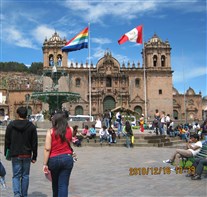
Main City Square in Cuzco, Peru
This is the next day. We had flown to Cuzco and were on a combination bus/walking tour of the city and several surrounding sites.
Cuzco is at elevation 11,200 feet above sea level. The previous day, we had been in Lima, which is on the ocean (although the area we stayed at might have been 200 feet above sea level). Cuzco seemed to be in a valley surrounded by mountains. I don't recall how the plane approached the airport -- or even if I noticed at that time.
I was not feeling well during the entire city tour -- almost certainly because of the altitude. In addition to not feeling well, I was surprised. I'd been at altitudes similar to this previously and never had any ill effects -- including skiing at similar (and, on a few occasions, even higher) altitudes. One difference here was going from near sea level to this altitude in just a few hours. When skiing, you are usually staying at a base that is 3000 feet (or less) lower than the peak altitude -- also you ski down to a somewhat lower elevation after (usually) spending just a few minutes up at the top.
This day at Cuzco apparently was, however, pretty effective acclimatization for the remainder of the trip, since I had no more problems -- including during the return to Cuzco about 3 days later.
I'm going to claim altitude sickness as an escuse for what seems like some pretty bland photos taken on this day.
Shutter Speed : 1/1243.34
Date Time : 2010:12:18 13:39:12
Equip Model : Canon PowerShot A495
ISO Speed : ISO-80
Focal Length : 6.6
Exposure Time : 0
Aperture : F/2.99
IMG_0882.jpg
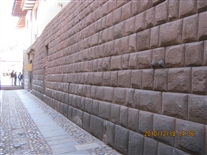
Cuzco Peru
This is one of the walls from the Inca era. Most of these longer walls were the foundation or "base mat" for the Inca buildings. After the conquest, the Spanish largely destroyed the older building and built churches and their municipal building on the older foundations and bases. At least, that's the impression I had. As indicated above, I was having trouble concentrating on what the tour guide was saying on this day.
Shutter Speed : 1/60.13
Date Time : 2010:12:18 14:36:39
Equip Model : Canon PowerShot A495
ISO Speed : ISO-250
Focal Length : 6.6
Exposure Time : 0.02
Aperture : F/2.99
IMG_0886.jpg
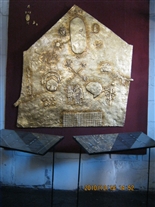
Cuzco Peru
This was in a building that is currently a convent, I think -- in a part of the facility that is a public chapel (and a tourist spot, I believe a ticket was required to enter). In this building, some of the original Inca structure seemed to still be partly intact -- incorporated into the Colonial-era building.
There had been a number of golden plates or shields on a wall here, with designs molded into the plates. There were historical or religious meaning to the design. The Spanish melted these down for the gold. However, the designs on a few of them were copied into a notebook or diary (it's unknown how accurate the drawing is at representing the original). This is a brass or copper "reproduction" one of the original plates based on one of those drawings. As best I recall, this was perhaps 4 feet high and 3.5 feet across.
Shutter Speed : 1/19.84
Date Time : 2010:12:18 14:52:17
Equip Model : Canon PowerShot A495
ISO Speed : ISO-640
Focal Length : 6.6
Exposure Time : 0.05
Aperture : F/2.99
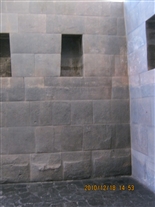
IMG_0887.jpg
Cuzco Peru
Part of another Inca structure incorporated into the later Colonial-era building (as are the next two).
Shutter Speed : 1/12.91
Date Time : 2010:12:18 14:53:28
Equip Model : Canon PowerShot A495
ISO Speed : ISO-800
Focal Length : 6.6
Exposure Time : 0.08
Aperture : F/2.99
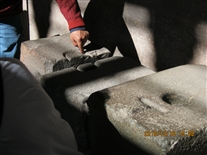
IMG_0888.jpg
Cuzco Peru
Guide is pointing to a horseshoe-shaped groove cut into two adjacent blocks. In the original sturcture, they poured molten gold into these grooves. The gold would solidify forming sort of a hook-shaped metal bar that acted to tie the two stones together. This helped the wall withstand sideways shaking forces during earthquakes. They think some of these gold "tie rods" are still present in some wall secions that were never torn down (but are now in the foundations of large structures).
Shutter Speed : 1/634.73
Date Time : 2010:12:18 15:08:53
Equip Model : Canon PowerShot A495
ISO Speed : ISO-125
Focal Length : 12.05
Exposure Time : 0
Aperture : F/4

IMG_0890.jpg
Cuzco Peru
Another view of the grooves for "tie rods".
Shutter Speed : 1/125.37
Date Time : 2010:12:18 15:09:44
Equip Model : Canon PowerShot A495
ISO Speed : ISO-160
Focal Length : 17.55
Exposure Time : 0.01
Aperture : F/5.03
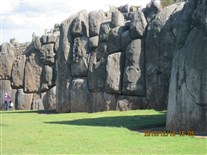
IMG_0896.jpg
Sacsayhuaman
This is large (immense!) area a short distance outside the city. It is called a fortress, but probably had a religious puirpose too.
The pronouncation is something very close to the English phrase "sexy woman". As you go from place to place as a tourist in Cuzco, one local or another will try to tell you about the "sexy woman" thing about once per hour.
As I went through the photos I had sorted out some months ago for eventual display, I realized I had picked only one photo of this place -- this one. I will probably add a couple more before putting this gallery up on the web. However, I suspect I don't have one that comes close to capturing how huge it is (or how huge some of these individual stone blocks are).
They know where these stones were quarried. If I remember correctly, most of them -- including the largest ones -- were brought from about 3-5 miles away (traces of the road are still visible). They were brought by human power. The Inca civilization (and the pre-Incas and all of the pre-Columbian civilizations) did not use wheeled transport vehicles and had no draft animals larger than a llama. Apparently, the maximum load a llama can carry is somewhat less than the load a man or woman can carry.
As I said before, this place is just outside Cuzco. I believe here (unlike Machu Picchu) many of the original stones were moved for use in construction in the city after the Spanish arrived.
Shutter Speed : 1/202.25
Date Time : 2010:12:18 16:05:32
Equip Model : Canon PowerShot A495
ISO Speed : ISO-160
Focal Length : 21.6
Exposure Time : 0
Aperture : F/5.78
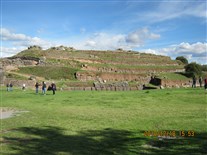
IMG_0891.jpg
Sacsayhuaman
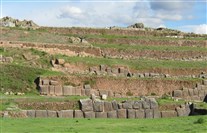
As suggested by the description for the previous photo, I did not (and still do not) like many of my photos of this place (which could be because I was not feeling well on this day). However, it deserves a couple more views. I have added this photo and the next one (which is a cropped version of this one) to highlight the structure of these walls.
The fortress (or monument or ceremonial site -- whatever it is) would look roughly like the letters "I L" if viewed from above, where the two letters represented steep hillsides faced with stone retaining walls (including some VERY large stones. The space between the two letters is a narrow valley. This photo looks onto the lower surface of the bottom bar of the "L" from ground level, not from above.
The previous photo is a shot of a portion of the face of the long bar of the "L".
Shutter Speed : 1/1002.93
Date Time : 2010:12:18 15:53:01
Equip Model : Canon PowerShot A495
ISO Speed : ISO-80
Focal Length : 6.6
Exposure Time : 0
Aperture : F/2.99
IMG_0891A.jpg
Sacsayhuaman
This photo was cropped to try to show more of a close-up of a section of the portion of the structure that is shown in the previous photo. I wanted to show details of the walls.
Note that this side of the structure is a series of terraces.
Also, note how the retaining walls are a mixture of large stones and smaller stones in a mortar or concrete matrix. I suspect the large stones are original and the rest of the structure was installed in modern times (the last 30-50 years) to stabilize the hillside. I'm guessing more of the hillside facade (perhaps all of it) was once covered with larger stones. However, these have probably been taken (and most of them broken up) to serve as building materials as Cuzco grew.
Shutter Speed : 1/1002.93
Date Time : 2010:12:18 15:53:01
Equip Model : Canon PowerShot A495
ISO Speed : ISO-80
Focal Length : 6.6
Exposure Time : 0
Aperture : F/2.99
IMG_0911A.jpg
Near Cuzco Peru
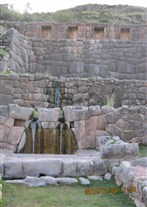
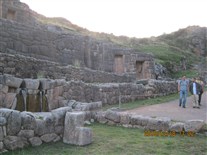
This photo and the next one are a temple built at a natural spring.
The upper portion shows a typical stone wall built by shaping stones to fit tightly into one another without any concrete or mortar of any kind. Well, perhaps this is not typical, but rather much better than average.
To get to this, we walked perhaps 1/4 mile on a trail that in Inca days eventually led to Machu Picchu (and some of their other towns). At this point, we were perhaps 65 or 70 miles from Machu Picchu. The Inca trail hike that tourists take starts closer to Machu Picchu. That hike covers 4 days, covering about the last 25 miles, with (as I understand it) the hiking part in the first three days. The 4th day you are AT Machu Picchu, arriving there -- at the Sun Gate -- at daybreak followiing a pre-dawn wake-up and breakfast. I did not do that, but Natalie Goff did it a few years earlier.
Shutter Speed : 1/202.25
Date Time : 2010:12:18 17:20:12
Equip Model : Canon PowerShot A495
ISO Speed : ISO-400
Focal Length : 6.6
Exposure Time : 0
Aperture : F/2.99
IMG_0913.jpg
Near Cuzco Peru
Shutter Speed : 1/125.37
Date Time : 2010:12:18 17:22:21
Equip Model : Canon PowerShot A495
ISO Speed : ISO-160
Focal Length : 6.6
Exposure Time : 0.01
Aperture : F/2.99
IMG_0918.jpg
Near Cuzco Peru
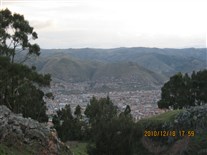
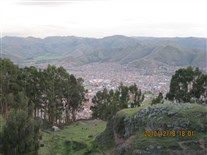
This is at a temple where there is an overlook panoramic view of the city of Cuzco.
Shutter Speed : 1/79.34
Date Time : 2010:12:18 17:59:17
Equip Model : Canon PowerShot A495
ISO Speed : ISO-160
Focal Length : 9.84
Exposure Time : 0.01
Aperture : F/3.51
IMG_0921.jpg
Near Cuzco Peru
Taken from same location as previous photo. I think it was here that I realized what a bowl-shaped depresssion (surrounded my mountains) the city as in -- and started to wonder where the airport was and how planes approached that airport.
Shutter Speed : 1/60.13
Date Time : 2010:12:18 18:01:03
Equip Model : Canon PowerShot A495
ISO Speed : ISO-250
Focal Length : 8.06
Exposure Time : 0.02
Aperture : F/3.18
IMG_0934.jpg
Train to Aguas Calentes
Aguas Calentes is the small town at the base of the road to Machu Picchu. The train trip is something like 114 km, and they provide a printed "program" describing sights on each section of the road.
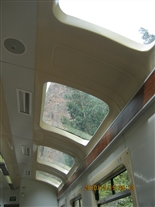
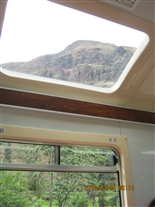
These windows are up near the roofline and in the roof of the rail car.
I was (and still am) confused by this trip. The year we went there seemed to be three classes of service, with the top level called something like the Vista Trail. We took the middle of the tree levels. Because we were not on the "vista" train, I wasn't expecting to be a car which had these windows that allowed passengers to look upward toward the mountain peaks (the train goes thru steep-walled narrow valleys for much of its route). However, we were in that car. I think the top class of service may have included a hot meal and entertainment in the cars during the trip.
Shutter Speed : 1/501.46
Date Time : 2010:12:19 09:13:51
Equip Model : Canon PowerShot A495
ISO Speed : ISO-160
Focal Length : 6.6
Exposure Time : 0
Aperture : F/2.99
IMG_0935.jpg
Train to Aguas Calentes
Shutter Speed : 1/317.37
Date Time : 2010:12:19 09:14:07
Equip Model : Canon PowerShot A495
ISO Speed : ISO-160
Focal Length : 6.6
Exposure Time : 0
Aperture : F/2.99
IMG_0945.jpg
Train to Aguas Calentes
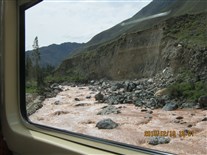
Train was beside this river much of the way. There were perhaps 30-35 miles of almost continous Class IV (or better) rapids during a partion of the trip.
Shutter Speed : 1/1002.93
Date Time : 2010:12:19 10:01:04
Equip Model : Canon PowerShot A495
ISO Speed : ISO-125
Focal Length : 6.6
Exposure Time : 0
Aperture : F/4.5

IMG_0931A.jpg
Train to Aguas Calentes
Taken from the train. I was interested in these building (and walls) made of mud bricks. The ceramic tile "roof" over the wall is to prevent rainfall directly onto the top of the wall, which causes it to "dissolve". Occasionally, we would pass a wall with a piece of tile missing. There was usually rain damage to the wall in those spots. However, it looked like the walls eventually had to be rebuilt even due to "dissovling" even in cases where the tile stayed intact.
Shutter Speed : 1/501.46
Date Time : 2010:12:19 08:31:03
Equip Model : Canon PowerShot A495
ISO Speed : ISO-320
Focal Length : 21.6
Exposure Time : 0
Aperture : F/5.78
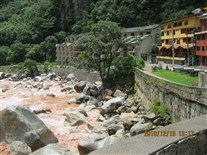
IMG_0979.jpg
Aguas Calentes
Town is at the bottom of a very narrow valley, with a river "falling" down a set of rapids as it passes thru the town.
Hotel was downhill from the rail station. This was taken from near the rail station, looking downstream. Hotel is one of the buildings on the right side of this photo.
Shutter Speed : 1/1243.34
Date Time : 2010:12:19 13:17:41
Equip Model : Canon PowerShot A495
ISO Speed : ISO-125
Focal Length : 6.6
Exposure Time : 0
Aperture : F/2.99
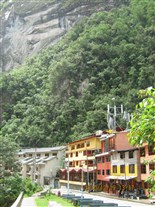
IMG_0977.jpg
Aguas Calentes
Looking downstream again. Hotel is on the right.
Shutter Speed : 1/250.73
Date Time : 2010:12:19 13:17:17
Equip Model : Canon PowerShot A495
ISO Speed : ISO-80
Focal Length : 6.6
Exposure Time : 0
Aperture : F/2.99
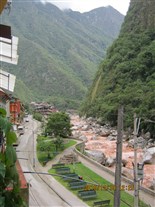
IMG_0970.jpg
Aguas Calentes
From hotel, looking up the street. Now river rapids are on the right.
Shutter Speed : 1/202.25
Date Time : 2010:12:19 12:25:24
Equip Model : Canon PowerShot A495
ISO Speed : ISO-160
Focal Length : 6.6
Exposure Time : 0
Aperture : F/2.99
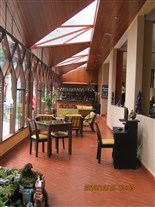
IMG_0976.jpg
Aguas Calentes
Interior of hotel -- lobby area.
Shutter Speed : 1/60.13
Date Time : 2010:12:19 13:05:46
Equip Model : Canon PowerShot A495
ISO Speed : ISO-160
Focal Length : 6.6
Exposure Time : 0.02
Aperture : F/2.99
IMG_0964.jpg
Aguas Calentes
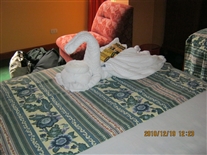
Interior of hotel room. Staff provided a towel animal both nights.
Shutter Speed : 1/60.13
Date Time : 2010:12:19 12:23:46
Equip Model : Canon PowerShot A495
ISO Speed : ISO-800
Focal Length : 6.6
Exposure Time : 0.02
Aperture : F/2.99

IMG_1252.jpg
Aguas Calentes
Shutter Speed : 1/50.56
Date Time : 2010:12:20 15:09:31
Equip Model : Canon PowerShot A495
ISO Speed : ISO-640
Focal Length : 6.6
Exposure Time : 0.02
Aperture : F/2.99
IMG_0981.jpg
Aguas Calentes
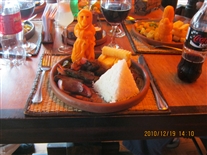
Lunch. The pyramid is made from rice. The "person" seemed to be a carved sweet potato, which I assumed was supposed to be a non-edible decoration.
Shutter Speed : 1/19.84
Date Time : 2010:12:19 14:10:33
Equip Model : Canon PowerShot A495
ISO Speed : ISO-500
Focal Length : 6.6
Exposure Time : 0.05
Aperture : F/2.99

IMG_0990.jpg
Aguas Calentes
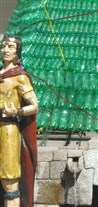
Main city square. The "tree" is made from 2-liter soft drink bottles (detail shown on next photo).
Saw several statues like this of Inca kings. I suspect they are all supposed to be representations of the great king who unified (created? expanded?) the Inca empire, arouund the 1470s, I think it was. I believe his name was Pachacuti (a name that might be spelled various ways -- and he may have been known by other names at various times in his life).
Based on my education in the US (in the 1950s), I came away with the feeling that (to those of us in the US) the history of the US in (say) the year 1200 was basically the history of England,
My impression in Peru was that they view things differently. They don't think of their history in (again, say) the 1200 as the history of Spain, but rather the history of the pre-Columbian civilizations. The Spainish seem to be "remembered" as conquerors and occupiers. (I suspect the people in, say, Buenos Aires, think of their pre-Columbian history more like I do.)
Shutter Speed : 1/809
Date Time : 2010:12:19 14:56:02
Equip Model : Canon PowerShot A495
ISO Speed : ISO-80
Focal Length : 9.84
Exposure Time : 0
Aperture : F/3.51
IMG_0991A.jpg
Aguas Calentes
Shutter Speed : 1/317.37
Date Time : 2010:12:19 14:56:11
Equip Model : Canon PowerShot A495
ISO Speed : ISO-80
Focal Length : 21.6
Exposure Time : 0
Aperture : F/5.78
IMG_0992.jpg
Aguas Calentes
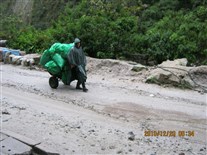
Street coming down to hotel from rail station. Looked like a lot of supplies for hotels and other businesses on the street were transported in this way. Street was pretty steep. However, the valley was so narrow there weren't many other places to build.
Shutter Speed : 1/125.37
Date Time : 2010:12:20 06:34:10
Equip Model : Canon PowerShot A495
ISO Speed : ISO-400
Focal Length : 6.6
Exposure Time : 0.01
Aperture : F/2.99

IMG_0994.jpg
Aguas Calentes
I suspect I took this because I was interested in the Spanish Railroad Crossing sign.
The "wall" of trees in the background may give some idea of how steep the walls of the valley are.
Shutter Speed : 1/19.84
Date Time : 2010:12:20 06:34:30
Equip Model : Canon PowerShot A495
ISO Speed : ISO-500
Focal Length : 21.6
Exposure Time : 0.05
Aperture : F/5.78
IMG_1149.jpg
Machu Picchu
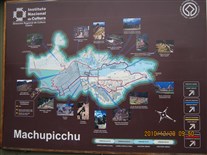
Taken the next day. This is a map near the entrance to the archelogical area. It shows the primarily archeological (tourist) area. Some places of interest (such as sun gate and the Inca Bridge) are off this map (I didn't go to the Sun Gate).
Note where north is on this map.
Juat outside the entrance to the area is the bus drop off and pickup area, a small (very top-$) hotel, a snack bar, and rest rooms (not free). They served lunch in the restaruant of the hotel (for after the morning tour), but we did not partake).
Shutter Speed : 1/501.46
Date Time : 2010:12:20 09:50:01
Equip Model : Canon PowerShot A495
ISO Speed : ISO-80
Focal Length : 6.6
Exposure Time : 0
Aperture : F/2.99

IMG_1001.jpg
Machu Picchu
This photo was taken near the entrance to the ruins, just after exiting the bus that had brought us up from the valley floor. The route up was a winding road with MANY switchbacks.
Here I'm facing back toward the valley we had just come from. The river can be seen down at the bottom of the valley. The clouds BELOW this point are also visible in this photo. The town of Aguas Calentes is not visible from here. It is behind the peak on the right hand side of this photo.
The overcast sky (and, I guess the "undercast" clouds below us) ensured I didn't get any photos with bright colors. On the other hand, the made for kind of a mystic spooky atmosphere, which was appealing in its own way.
Shutter Speed : 1/60.13
Date Time : 2013:02:25 22:46:37
Equip Model : Canon PowerShot A495
ISO Speed : ISO-160
Focal Length : 6.6
Exposure Time : 0.02
Aperture : F/2.99
IMG_1005.jpg
Machu Picchu
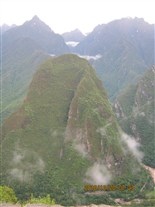
This was taken from the same point as the previous photo. I was facing a bit toward the left of where I was facing when the previous photo was taken.
Shutter Speed : 1/60.13
Date Time : 2013:02:25 22:46:45
Equip Model : Canon PowerShot A495
ISO Speed : ISO-160
Focal Length : 6.6
Exposure Time : 0.02
Aperture : F/2.99

IMG_1006A.jpg
Machu Picchu
This is a few minutes later. This was taken after we had gone thru the gate and were at the edge of the area of Machu Picchu ruins.
The city is on a saddle-shaped area between two mountains,. The main axis of the city (of the saddle) runs roughly south-north. A peak named Machu Picchu is on the south end (actually perhaps a bit east of south. A mountain named Huayna Picchu is near the north end. Huayna Picchu has at least two named peaks, The tow names I encountered seemed to be called Little Huayna Picchu and Big Huayna Picchu (as best I could tell and can remember).
We entered the "city" (the ruins) on the east side of the "saddle" in what had been a terraced agriculturual area.
The various directions I'm throwing around are based soley on the map shown a few photos ago. While there (on a cloudy. rainy day), I was completely turned around and had no idea where any direction was.
Shutter Speed : 1/125.37
Date Time : 2010:12:20 07:26:18
Equip Model : Canon PowerShot A495
ISO Speed : ISO-160
Focal Length : 6.6
Exposure Time : 0.01
Aperture : F/2.99
IMG_1009.jpg
Machu Picchu
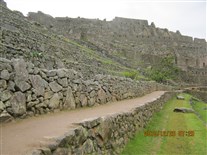
Closer view of the terraces is on the left side of this photo. The buildings at top center and top right had been a residential area, I believe.
One of the terraces has an asphalt walking path on it (they try to direct tourists to that terrace).
As indicated in the Information About This Gallery section, I don't understand how different this is from the way it was discovered and how much was reconstructed. It's difficult for me to visualize these retaining walls could have been in this condition following several hundred years of uncontrolled jungle overgrowth. I suspect some kind of recontruction must have been done to restore them to this condtion.
Shutter Speed : 1/158.68
Date Time : 2010:12:20 07:29:03
Equip Model : Canon PowerShot A495
ISO Speed : ISO-160
Focal Length : 6.6
Exposure Time : 0.01
Aperture : F/2.99
IMG_1012.jpg
Machu Picchu
Shutter Speed : 1/79.34
Date Time : 2013:02:25 21:24:32
Equip Model : Canon PowerShot A495
ISO Speed : ISO-160
Focal Length : 6.6
Exposure Time : 0.01
Aperture : F/2.99
IMG_1014.jpg
Machu Picchu
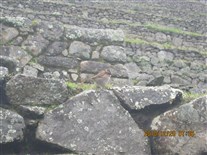
Not sure what kind of bird this is.
Shutter Speed : 1/101.13
Date Time : 2010:12:20 07:36:28
Equip Model : Canon PowerShot A495
ISO Speed : ISO-400
Focal Length : 21.6
Exposure Time : 0.01
Aperture : F/5.78

IMG_1016A.jpg
Machu Picchu
A different kind of bird.
Shutter Speed : 1/125.37
Date Time : 2010:12:20 07:49:19
Equip Model : Canon PowerShot A495
ISO Speed : ISO-100
Focal Length : 21.6
Exposure Time : 0.01
Aperture : F/5.78
IMG_1018.jpg
Machu Picchu
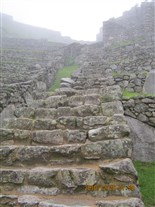
This is looking up a stairway at the end of this set of terraces. It goes up into the more urban part of the city. On these photos, the stairways seem easier to recognize from a distance that when you are right on top of one.
Shutter Speed : 1/125.37
Date Time : 2013:02:25 21:26:05
Equip Model : Canon PowerShot A495
ISO Speed : ISO-160
Focal Length : 6.6
Exposure Time : 0.01
Aperture : F/2.99
IMG_1019.jpg
Machu Picchu
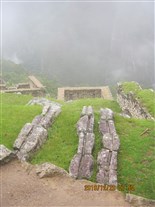
This is looking downward. You can see more clouds below us.
The two lines of dressed stones have a groove cut in the top surface. These grooves are channels for water flow. They are apparently part of an irrigation system for the terraces.
Shutter Speed : 1/60.13
Date Time : 2013:02:25 22:46:41
Equip Model : Canon PowerShot A495
ISO Speed : ISO-80
Focal Length : 6.6
Exposure Time : 0.02
Aperture : F/2.99
IMG_1021.jpg
Machu Picchu
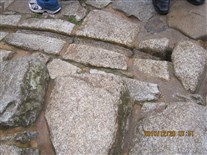
Looking down at the pavement we are standing on here. The groove shown here directs water to the grooves shown in the previous photo.
The water channel runs from near the top right left hand corner to near the right hand edge of the photo. At that point the flowing water would fall into a crevice in this layer of the pavement.
Shutter Speed : 1/79.34
Date Time : 2010:12:20 07:51:44
Equip Model : Canon PowerShot A495
ISO Speed : ISO-80
Focal Length : 6.6
Exposure Time : 0.01
Aperture : F/2.99
IMG_1020.jpg
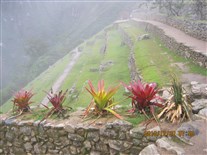
Machu Picchu
Looking back across the terraces toward where we entered the ruins (the entrance point is not really visible from here). The grass-covered terraces are close to the original. The ones with paved tops have been modified to be paths for visitors.
Shutter Speed : 1/79.34
Date Time : 2010:12:20 07:50:40
Equip Model : Canon PowerShot A495
ISO Speed : ISO-80
Focal Length : 6.6
Exposure Time : 0.01
Aperture : F/2.99

IMG_1025.jpg
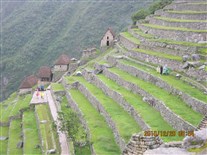
Machu Picchu
Looking back across the terraces. The people visible on some of the terraces gives some idea of the immense scale of this place.
The two buildings (eith thatched roofs) at lower left were where we entered the terrace area (following a walk of perhaps 200-300 fee)t from the gate where they collected tickets, etc. They think these were storage building for food products grown on these terrace farms I;m facing roughtly south here.
The buildiings are covered by thatched roofs. Only a few buildings currently have roofs. They are, of course, reconstructions to give visitors some idea of what many of the other buildings looked like when the city was alive.
Shutter Speed : 1/125.37
Date Time : 2010:12:20 07:54:11
Equip Model : Canon PowerShot A495
ISO Speed : ISO-160
Focal Length : 6.6
Exposure Time : 0.01
Aperture : F/2.99
IMG_1042.jpg
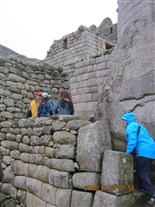
Machu Picchu
This is another photo looking back across the terraces on the west side (west slope) of the "saddle".
Shutter Speed : 1/79.34
Date Time : 2010:12:20 08:04:41
Equip Model : Canon PowerShot A495
ISO Speed : ISO-125
Focal Length : 12.05
Exposure Time : 0.01
Aperture : F/4
IMG_1027.jpg
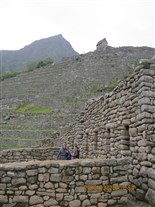
Machu Picchu
Going up out of the terrace area into a temple (or what's believed to have been a temple -- there is probably SOME uncertainty in the purpose or use of these building and areas).
Shutter Speed : 1/125.37
Date Time : 2013:02:25 21:37:19
Equip Model : Canon PowerShot A495
ISO Speed : ISO-160
Focal Length : 6.6
Exposure Time : 0.01
Aperture : F/2.99
IMG_1028.jpg
Machu Picchu
Small building at top is called the gate house. The trails from Cuzco (and other areas to the south) originally ended (entered the city) near this building.
Shutter Speed : 1/125.37
Date Time : 2013:02:25 21:39:32
Equip Model : Canon PowerShot A495
ISO Speed : ISO-160
Focal Length : 6.6
Exposure Time : 0.01
Aperture : F/2.99
IMG_1029.jpg
Machu Picchu
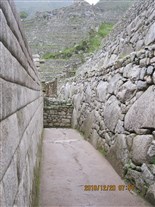
A walkway between two walls. The wall on the left is part of a building. I'm not sure if the one on the opposite side is a building or a retaining wall.
They consider the walls in the city were built in about there different quality levels, with the wall on the left side of this photo being on the highest quality. The theory is that the highest quality walls represent the buildings with the highest-status purposes, such as temples and royal residences.
Shutter Speed : 1/317.37
Date Time : 2013:02:25 22:46:36
Equip Model : Canon PowerShot A495
ISO Speed : ISO-400
Focal Length : 6.6
Exposure Time : 0
Aperture : F/2.99

IMG_1033.jpg
Machu Picchu
Looking across at a staircase going up to an area of a temple and (possibly) residences of elite citizens. Photos of the stone staircases are easier to recognize from a distance that in a photo taken while standing on a staircase.
Shutter Speed : 1/79.34
Date Time : 2010:12:20 08:00:19
Equip Model : Canon PowerShot A495
ISO Speed : ISO-160
Focal Length : 12.05
Exposure Time : 0.01
Aperture : F/4
IMG_1041.jpg
Machu Picchu
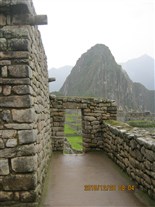
Trapozoidal doorways and windows are characteristic of the Inca architecture.
The mountain in the background is Huayna Picchu.
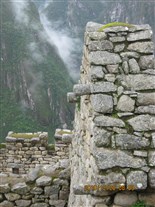
The small cylindrical stones projecting out from near the top of the wall at left were used to attach the thatched roofs.
Shutter Speed : 1/158.68
Date Time : 2013:02:25 22:46:39
Equip Model : Canon PowerShot A495
ISO Speed : ISO-160
Focal Length : 6.6
Exposure Time : 0.01
Aperture : F/2.99
IMG_1045.jpg
Machu Picchu
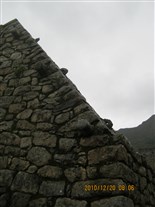
Another look at the stonework used for roof attachments.
The are sort of cylindrical horizontal "tie posts" facing me and stone "eyelets" along the slanting edge of the wall that formed a gable.
Shutter Speed : 1/501.46
Date Time : 2013:02:25 22:46:33
Equip Model : Canon PowerShot A495
ISO Speed : ISO-125
Focal Length : 6.6
Exposure Time : 0
Aperture : F/2.99
IMG_1046.jpg
Machu Picchu
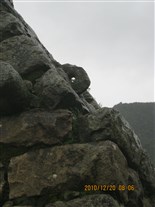
Closeup of a stone eyelet. This is what a geek engineer looks at in a place like this.
Shutter Speed : 1/202.25
Date Time : 2013:02:25 22:46:39
Equip Model : Canon PowerShot A495
ISO Speed : ISO-160
Focal Length : 21.6
Exposure Time : 0
Aperture : F/5.78

IMG_1047A.jpg
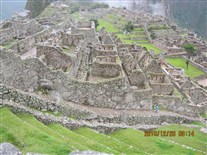
Machu Picchu
Some light rain fell one and off during the day.
Shutter Speed : 1/158.68
Date Time : 2010:12:20 08:12:32
Equip Model : Canon PowerShot A495
ISO Speed : ISO-160
Focal Length : 6.6
Exposure Time : 0.01
Aperture : F/2.99
IMG_1049.jpg
Machu Picchu
Quite a lot in this photo. This is taken from higher upslope toward the south, but facing roughly north.
There are terraces at bottom. Then a stone stairway (with people on it). Then residences and (probably) food storage buildings above that. The round building at right center is a temple or tower. That's near where we first entered the area of buildings from the agricultural terraces to the on the south side (where we first came onto the site).
The green area (between buildings) near the top may have been a ballfield or a ceremonial area. I think the map at the beginning calls it the main town square.
Shutter Speed : 1/79.34
Date Time : 2010:12:20 08:14:35
Equip Model : Canon PowerShot A495
ISO Speed : ISO-80
Focal Length : 6.6
Exposure Time : 0.01
Aperture : F/2.99

IMG_1051.jpg
Machu Picchu
I'm near or at the point the previous photo was taken, but this is a more wide-angle shot, still facing roughly north.
The mountaiin in the background is Huayna Picchu. In this photo, the two peaks (Big and Little) are clearly visible. There are apparently temples (or other types of ceremonial buidings) on each of them.
Shutter Speed : 1/317.37
Date Time : 2013:02:25 22:11:04
Equip Model : Canon PowerShot A495
ISO Speed : ISO-160
Focal Length : 6.6
Exposure Time : 0
Aperture : F/2.99
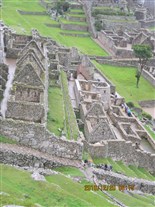
IMG_1052.jpg
Machu Picchu
Moving a little higher up a trail toward the west (and the general direction of the Gate House seen earlier). Here the round tower building can be seen a bit more clearly.
Shutter Speed : 1/79.34
Date Time : 2013:02:25 22:14:26
Equip Model : Canon PowerShot A495
ISO Speed : ISO-100
Focal Length : 12.05
Exposure Time : 0.01
Aperture : F/4
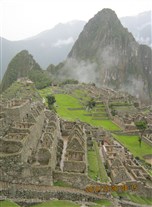
IMG_1053A.jpg
Machu Picchu
This is close to the classic view seen in photos taken by so many visitors.
Shutter Speed : 1/202.25
Date Time : 2010:12:20 08:15:51
Equip Model : Canon PowerShot A495
ISO Speed : ISO-160
Focal Length : 6.6
Exposure Time : 0
Aperture : F/2.99

IMG_1057A.jpg
Machu Picchu
Shutter Speed : 1/202.25
Date Time : 2010:12:20 08:17:42
Equip Model : Canon PowerShot A495
ISO Speed : ISO-160
Focal Length : 6.6
Exposure Time : 0
Aperture : F/2.99

IMG_1058.jpg
Machu Picchu
Shutter Speed : 1/250.73
Date Time : 2013:02:25 22:17:59
Equip Model : Canon PowerShot A495
ISO Speed : ISO-160
Focal Length : 6.6
Exposure Time : 0
Aperture : F/2.99
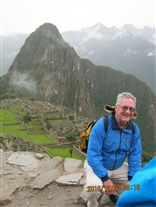
IMG_1061A.jpg
Machu Picchu
Paul Soper.
Shutter Speed : 1/250.73
Date Time : 2010:12:20 08:19:36
Equip Model : Canon PowerShot A495
ISO Speed : ISO-160
Focal Length : 6.6
Exposure Time : 0
Aperture : F/2.99

IMG_1066.jpg
Machu Picchu
Carl at Machu Picchu.
Shutter Speed : 1/501.46
Date Time : 2010:12:20 08:25:12
Equip Model : Canon PowerShot A495
ISO Speed : ISO-200
Focal Length : 6.6
Exposure Time : 0
Aperture : F/2.99
IMG_1069.jpg
Machu Picchu
Still fascinated by those stone roof attachment points.
Shutter Speed : 1/79.34
Date Time : 2013:02:25 22:46:37
Equip Model : Canon PowerShot A495
ISO Speed : ISO-80
Focal Length : 12.05
Exposure Time : 0.01
Aperture : F/4
IMG_1074.jpg
Machu Picchu
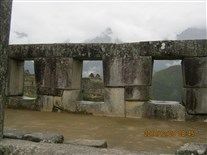
The room with three windows. Part of a movie called "The Motorcycle Diaries" was filmed here.
Shutter Speed : 1/634.73
Date Time : 2010:12:20 08:45:26
Equip Model : Canon PowerShot A495
ISO Speed : ISO-160
Focal Length : 6.6
Exposure Time : 0
Aperture : F/2.99
IMG_1075.jpg
Machu Picchu
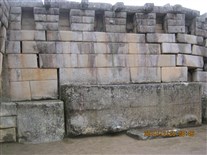
The trapizoidal openings here are niches that probalby once held statues or treasures of some kind. They are probably not windows that were later sealed.
I think the guide may have told us a story about the source of the damage to this room, but (if so) I've forgotten it.
The appearance of the large rectangular block at the base of the wall sure suggest an alter of some type to me. Also, its rougher surface (and the semi-finished appearance in its lower portion) suggests to me that if may initialy have been covered or hidden by something.
Shutter Speed : 1/202.25
Date Time : 2010:12:20 08:46:12
Equip Model : Canon PowerShot A495
ISO Speed : ISO-160
Focal Length : 6.6
Exposure Time : 0
Aperture : F/2.99
IMG_1079.jpg
Machu Picchu
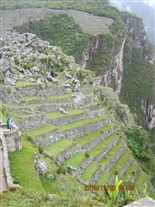
I'm kind of lost here. This seems to be a different terrace area, but I'm not sure where. There were perhaps 5 or 6 different agricultural terrace areas.
Shutter Speed : 1/125.37
Date Time : 2013:02:25 22:25:17
Equip Model : Canon PowerShot A495
ISO Speed : ISO-80
Focal Length : 6.6
Exposure Time : 0.01
Aperture : F/2.99
IMG_1085.jpg
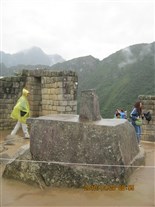
Machu Picchu
This carved rock was apparently used in varous ceremonies. I believe this is the place now called the observatory (but that may not be a totally accurate description of how the Incas used it.
Shutter Speed : 1/404.5
Date Time : 2013:02:25 22:46:33
Equip Model : Canon PowerShot A495
ISO Speed : ISO-160
Focal Length : 6.6
Exposure Time : 0
Aperture : F/2.99

IMG_1087.jpg
Machu Picchu
Shutter Speed : 1/501.46
Date Time : 2013:02:25 22:27:42
Equip Model : Canon PowerShot A495
ISO Speed : ISO-160
Focal Length : 6.6
Exposure Time : 0
Aperture : F/2.99
IMG_1090.jpg
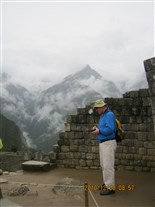
Machu Picchu
Paul Soper. Note clouds at our elevation (and lower) in the background (wihich is toward the south).
Shutter Speed : 1/1002.93
Date Time : 2013:02:25 22:27:57
Equip Model : Canon PowerShot A495
ISO Speed : ISO-160
Focal Length : 6.6
Exposure Time : 0
Aperture : F/2.99
IMG_1091.jpg
Machu Picchu
Shutter Speed : 1/501.46
Date Time : 2013:02:27 23:16:27
Equip Model : Canon PowerShot A495
ISO Speed : ISO-160
Focal Length : 6.6
Exposure Time : 0
Aperture : F/2.99
IMG_1096.jpg
Machu Picchu
The ceremonial area (or ballfield? or town square?) seen from a distance in an earlier photo. Here the terraces (generally wider than those seen earlier) are probably not agricultural, but rather an area where people stood or sat during ceremonies (or ball games?).
Shutter Speed : 1/158.68
Date Time : 2010:12:20 09:06:00
Equip Model : Canon PowerShot A495
ISO Speed : ISO-80
Focal Length : 6.6
Exposure Time : 0.01
Aperture : F/2.99
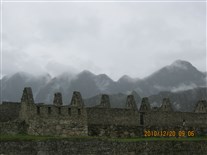
IMG_1098.jpg
Machu Picchu
Looking across at a group of buildings.
I'm not sure if the condition here is pretty much how Bingham found it, or if some reconstruction has been done. Even if reconstruction HAS been done, the fact that all the pieces are here shows that essentially none of the matereials have been carried off to be used as building materials at other locations. Many sets of ruins (such as the collosium in Rome) are no longer compete because for centuries they were used as quarries for materials for later buildings. Here there were no nearby settlements to use these stones.
Shutter Speed : 1/634.73
Date Time : 2010:12:20 09:06:46
Equip Model : Canon PowerShot A495
ISO Speed : ISO-125
Focal Length : 12.05
Exposure Time : 0
Aperture : F/4
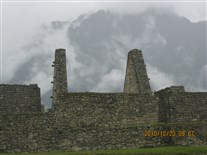
IMG_1099.jpg
Machu Picchu
Still fascinated by those stone roof attachment fixtures.
Shutter Speed : 1/250.73
Date Time : 2010:12:20 09:07:01
Equip Model : Canon PowerShot A495
ISO Speed : ISO-125
Focal Length : 21.6
Exposure Time : 0
Aperture : F/5.78
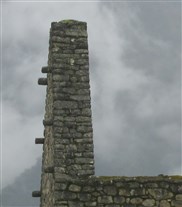
IMG_1099A.jpg
Machu Picchu
STILL fascinated by those stone roof attachment fixtures.
Shutter Speed : 1/250.73
Date Time : 2010:12:20 09:07:01
Equip Model : Canon PowerShot A495
ISO Speed : ISO-125
Focal Length : 21.6
Exposure Time : 0
Aperture : F/5.78
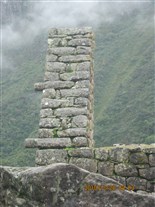
IMG_1126.jpg
Machu Picchu
Yet another engineer geek photo of a stone "tie rod". This photo is displayed here out of sequence.
Shutter Speed : 1/125.37
Date Time : 2013:02:27 22:32:55
Equip Model : Canon PowerShot A495
ISO Speed : ISO-125
Focal Length : 21.6
Exposure Time : 0.01
Aperture : F/5.78
IMG_1104.jpg
Machu Picchu
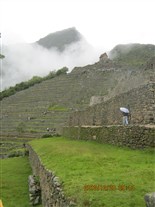
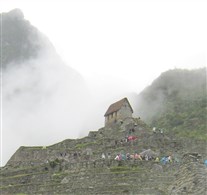
Now I'm facing the other direction (roughly south), looking up toward the peak called Machu Picchu. That is the gate house at the top, and a different agricultural terraced area. The map in an earlier photograph may use the term "Guard House" for what I'm callng the Gate House.
Note the row of people along the sloped path in the upper right quadrant of this photo.
The next photo is cropped version of this photo, attempting to give some idea of the immense scale of these ruins.
Shutter Speed : 1/501.46
Date Time : 2013:02:25 22:33:35
Equip Model : Canon PowerShot A495
ISO Speed : ISO-160
Focal Length : 6.6
Exposure Time : 0
Aperture : F/2.99
IMG_1104A.jpg
Machu Picchu
Cropped version of previous photo.
Shutter Speed : 1/501.46
Date Time : 2010:12:20 09:13:32
Equip Model : Canon PowerShot A495
ISO Speed : ISO-160
Focal Length : 6.6
Exposure Time : 0
Aperture : F/2.99
IMG_1109.jpg
Machu Picchu
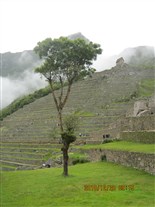
I'm not sure why the tree is there. It might indicate some trees were present in the city in the Inca era. Or maybe it isupposed to give some idea of the types of trees that have covered the site prior to the 1911 "discovery".
Shutter Speed : 1/404.5
Date Time : 2013:02:25 22:43:40
Equip Model : Canon PowerShot A495
ISO Speed : ISO-160
Focal Length : 6.6
Exposure Time : 0
Aperture : F/2.99
IMG_1110.jpg
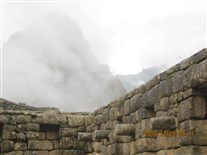
Machu Picchu
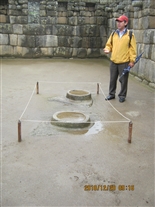
This is our guide (I believe we were in a group of seven people). We are in a building believed to be a temple. He is standing in front of two basins believed to have some kind of ceremonial use. This building was roofed in Inca days, but the roof has not been reconstructed.
Shutter Speed : 1/202.25
Date Time : 2013:02:25 22:44:21
Equip Model : Canon PowerShot A495
ISO Speed : ISO-80
Focal Length : 6.6
Exposure Time : 0
Aperture : F/2.99
IMG_1112.jpg
Machu Picchu
More of those stone "tie bars," but these seem to have some different function. They are lower from the roof line than the others and seem to project out further. Also, they are not on the roof gable like the others. Finally, they seem to be on the inside of the building, while the others are on the outside.
I believe all the things that seem to be "windows" here are actually small alcoves (similar to the one in the background). Perhaps a wooden shelf of some kind (or possibly a loft) rested on the cylindrical stones projecting out from the wall.
Shutter Speed : 1/202.25
Date Time : 2010:12:20 09:17:12
Equip Model : Canon PowerShot A495
ISO Speed : ISO-160
Focal Length : 14.8
Exposure Time : 0
Aperture : F/4.5

IMG_1113.jpg
Machu Picchu
Not sure if this is a "roof" one or of a "shelf" one.
Shutter Speed : 1/101.13
Date Time : 2010:12:20 09:17:56
Equip Model : Canon PowerShot A495
ISO Speed : ISO-125
Focal Length : 14.8
Exposure Time : 0.01
Aperture : F/4.5
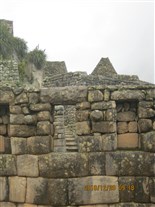
IMG_1114.jpg
Machu Picchu
Here you can see a true window bracketed by two alcoves.
Shutter Speed : 1/202.25
Date Time : 2013:02:27 23:17:18
Equip Model : Canon PowerShot A495
ISO Speed : ISO-160
Focal Length : 14.8
Exposure Time : 0
Aperture : F/4.5

IMG_1116.jpg
Machu Picchu
Looking south from this area of temples.
Shutter Speed : 1/202.25
Date Time : 2013:02:27 23:16:27
Equip Model : Canon PowerShot A495
ISO Speed : ISO-160
Focal Length : 17.55
Exposure Time : 0
Aperture : F/5.03

IMG_1117A.jpg
Machu Picchu
Joanna Soper. Note that this doorway has a more complex design than most of the others. Also, not there is a series of doorways behind her.
Shutter Speed : 1/101.13
Date Time : 2010:12:20 09:19:10
Equip Model : Canon PowerShot A495
ISO Speed : ISO-80
Focal Length : 17.55
Exposure Time : 0.01
Aperture : F/5.03

IMG_1120.jpg
Machu Picchu
Another look at the terraced area where we first entered.
Shutter Speed : 1/404.5
Date Time : 2010:12:20 09:20:03
Equip Model : Canon PowerShot A495
ISO Speed : ISO-160
Focal Length : 6.6
Exposure Time : 0
Aperture : F/2.99
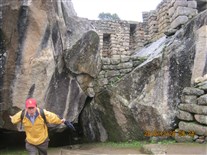
IMG_1128.jpg
Machu Picchu
This is a temple that has been incorporated pre-existing rocks into its design. The natural rocks, some carved rocks, and possibly parts of the building structure come together to form a giant sculpture of a bird (a condor, I believe). He is trying to use his body to help us see the form of the bird in the rocks.
Shutter Speed : 1/158.68
Date Time : 2010:12:20 09:24:26
Equip Model : Canon PowerShot A495
ISO Speed : ISO-160
Focal Length : 6.6
Exposure Time : 0.01
Aperture : F/2.99

IMG_1130.jpg
Machu Picchu
I believe this may have been the head of the condor.
Shutter Speed : 1/79.34
Date Time : 2013:02:27 23:16:27
Equip Model : Canon PowerShot A495
ISO Speed : ISO-80
Focal Length : 6.6
Exposure Time : 0.01
Aperture : F/2.99
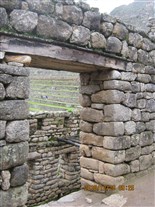
IMG_1131.jpg
Machu Picchu
Actually a wooden header beam is used here. I'm pretty sure this is a reconstruction, not several-hundred-year-old wood, but I could be wrong.
Shutter Speed : 1/101.13
Date Time : 2013:02:27 23:16:27
Equip Model : Canon PowerShot A495
ISO Speed : ISO-80
Focal Length : 6.6
Exposure Time : 0.01
Aperture : F/2.99
IMG_1132.jpg
Machu Picchu
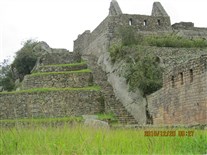
Part of the complex of buildings on the east side of the main town square.
Shutter Speed : 1/317.37
Date Time : 2010:12:20 09:27:40
Equip Model : Canon PowerShot A495
ISO Speed : ISO-160
Focal Length : 9.84
Exposure Time : 0
Aperture : F/3.51
IMG_1140.jpg
Machu Picchu
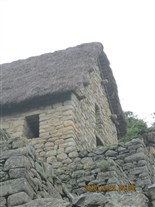
This was taken as we were leaving the ticketed part of the archeological site at the end of the portion of the tour where we had a guide with us. This is the same building we had gone thru to enter the first terraced area.
They have added a thatched roof to this building (and to a few others) to illustrate what the buildings looked like when this was a living city (there is probably some conjecture in the roof design, but it HAD to be SOMETHING along these lines). The roofed buildings also provide some shelter for tourists on rainy days (and perhaps some shade on sunny days).
Shutter Speed : 1/202.25
Date Time : 2013:02:27 22:39:42
Equip Model : Canon PowerShot A495
ISO Speed : ISO-160
Focal Length : 21.6
Exposure Time : 0
Aperture : F/5.78

IMG_1140A.jpg
Machu Picchu
This is a close up view to show how ropes are used to tie the roof to the horizontal "tie posts". The stone eyelets are covered by this roof, so it was not clear to me exactly how they were used in attaching this roof.
Shutter Speed : 1/202.25
Date Time : 2010:12:20 09:35:15
Equip Model : Canon PowerShot A495
ISO Speed : ISO-160
Focal Length : 21.6
Exposure Time : 0
Aperture : F/5.78
IMG_1141.jpg
Machu Picchu
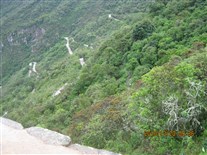
This was taken outside the main gate, looking down and across the slope we had come up on the bus. This shows some of the many switchbacks in the approach road. It's perhaps a 1000-1100 foot vertical difference from where a bridge crosses the river. The bridge is perhaps a mile from the center of Aguas Calentes -- and downriver, so the buses go "downhill" to reach the bridge, then back up this switchbacked approach road.
Shutter Speed : 1/125.37
Date Time : 2010:12:20 09:36:41
Equip Model : Canon PowerShot A495
ISO Speed : ISO-80
Focal Length : 6.6
Exposure Time : 0.01
Aperture : F/2.99
IMG_1150.jpg
Machu Picchu
Back to the archeological area.
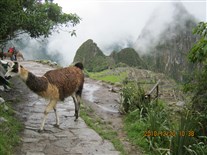
We had a snack (and a bathroom break) at a reception area just outside the gate. The others took a bus back into town, but I went back into the archeological area to explore some more.
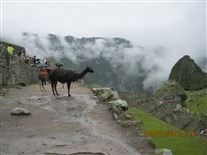
On the early-morning trip with the guide, we had gone directly out onto the terraced area. This enabled going up to a photo point along more gentle slopes -- going thru a portion of the city. This time, I took a cutoff to the left, before getting to the terraced area. This took me up a pretty steep trail (initially without any good views). When I did come to an area overlooking the city, llamas were there. Had heard there were llamas roaming around the area, but had not seen any during the morning trip with the guide.
Note the city on the right hand side of this photo, well below me. It looks like a steep dropoff in this photo. However, I don't recall anything scary here. Maybe I was winded from the hike up that steep trail.
Shutter Speed : 1/634.73
Date Time : 2010:12:20 10:38:36
Equip Model : Canon PowerShot A495
ISO Speed : ISO-160
Focal Length : 6.6
Exposure Time : 0
Aperture : F/2.99
IMG_1152.jpg
Machu Picchu
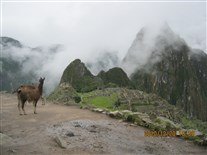
There might have been 6 or 7 llamas in this area. Note the clouds are at the same elevation that I was -- some of them lower.
Shutter Speed : 1/1243.34
Date Time : 2010:12:20 10:39:03
Equip Model : Canon PowerShot A495
ISO Speed : ISO-160
Focal Length : 6.6
Exposure Time : 0
Aperture : F/2.99
IMG_1155.jpg
Machu Picchu
The peak at the right is Huayna Picchu (actually it's probably what they seemed to call Big Huayna Picchu -- at least of the smaller ones in this view -- to the left of the big peak, in this photo-- is Little Huayna Oicchu).
Later in the day, I hiked up Big Huayna Picchu. If you look closely, in this photo, you can see sort of a rim or dropoff between the edge of the city and Big Huayna Picchu. That really exists, the first (perhaps) 1/4-mile of the hike "up" Big Huayna Picchu is a steep DOWNhill into a gorge between the city and Big Huayna Picchu. And every step down into that gorge, I was thinking about how that was one more step I was going to have to go up to get to the peak.
Shutter Speed : 1/1002.93
Date Time : 2010:12:20 10:39:37
Equip Model : Canon PowerShot A495
ISO Speed : ISO-160
Focal Length : 6.6
Exposure Time : 0
Aperture : F/2.99
IMG_1159.jpg
Machu Picchu
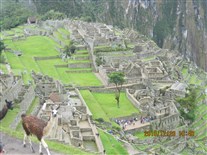
Llama posing above Machu Picchu.
Shutter Speed : 1/158.68
Date Time : 2010:12:20 10:40:21
Equip Model : Canon PowerShot A495
ISO Speed : ISO-80
Focal Length : 12.05
Exposure Time : 0.01
Aperture : F/4
IMG_1160.jpg
Machu Picchu
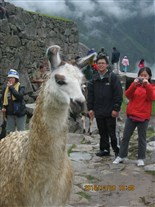
Typical Japanese tourists -- taking pictures of the llama. And then there's me -- taking pictures of the llama AND the Japanese tourists.
Shutter Speed : 1/404.5
Date Time : 2010:12:20 10:40:36
Equip Model : Canon PowerShot A495
ISO Speed : ISO-100
Focal Length : 12.05
Exposure Time : 0
Aperture : F/4
IMG_1170.jpg
Machu Picchu
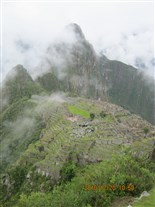
At this point, I was probably near the building seen in a much earlier photo that is called the Gate House.
Shutter Speed : 1/501.46
Date Time : 2013:02:26 17:25:59
Equip Model : Canon PowerShot A495
ISO Speed : ISO-160
Focal Length : 6.6
Exposure Time : 0
Aperture : F/2.99
IMG_1173A.jpg
Machu Picchu
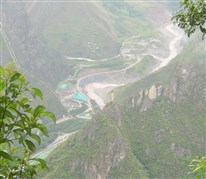
This is looking down the other (west) side of the saddle. That's the same river that flows thru Aguas Calentes, but the portion seen here is upstream of Aguas Calentes. There is a dam in this area and also the rail station just before Aguas Calentes.
When we left Aguas Calentes by train early (VERY early) the next morning, the train stopped at this station, and LOTS of men got on it (but in a different car that we were in -- we apparently had higher class tickets than they did). At the time, I thought they were shift workers from the dam, who had just got off work. However, later learned (partly from talking to Natalie) they were the guides and porters for groups that had been hiking the a Inca Trail (the 2-day or 4-day hikes). After the last night, everyone gets up VERY early. The hikers go on to Machu Picchu to watch the sunrise (if it is not cloudy, rainy, etc.). The porters, guides, etc., take a shortcut (a cutoff from the trail) down to this station and take the train home. Natailie said the last she saw the porters they were running down the hill (carrying large packs and bundles).
Shutter Speed : 1/317.37
Date Time : 2010:12:20 10:56:52
Equip Model : Canon PowerShot A495
ISO Speed : ISO-160
Focal Length : 6.6
Exposure Time : 0
Aperture : F/2.99
IMG_1181.jpg
Machu Picchu
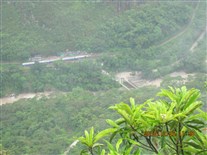
This photo and the next one are shown a bit out of sequence. Apparently different sections of the river were visible from different points on the trail. The dam can be seen in these photos, along with a train at the staion. This is upstream from Machu Picchu -- and also one station "up" toward Cuzco.
This is, again, looking down the "other" side of the mountain (or the "saddle"), opposite the side the bus access road is on.
Shutter Speed : 1/125.37
Date Time : 2010:12:20 11:38:55
Equip Model : Canon PowerShot A495
ISO Speed : ISO-125
Focal Length : 21.6
Exposure Time : 0.01
Aperture : F/5.78

IMG_1181A.jpg
Machu Picchu
Shutter Speed : 1/125.37
Date Time : 2010:12:20 11:38:55
Equip Model : Canon PowerShot A495
ISO Speed : ISO-125
Focal Length : 21.6
Exposure Time : 0.01
Aperture : F/5.78
IMG_1175.jpg
Machu Picchu
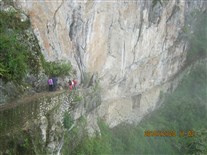
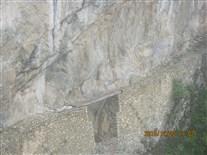
Here is one of the things I had come back into the archeological area to see. The second trail coming into Machu Picchu goes along a ledge on this sheer cliff. As you can see here, the ledge is artificial. It was constructed by the Inca stonemasons. They intentionally left a gap with a wooden bridge over it. If an enemy war party approached, the defenders of the city would remove the bridge (or perhaps burn it).
The ledge containing the bridged gap is in the lower portion of this image, with the gap below and slightly to the right of the center of this photo. The people at left are on a trail, which winds around (out of sight for a time) and drops down to became the trail along that artificial ledge.
Shutter Speed : 1/317.37
Date Time : 2010:12:20 11:02:49
Equip Model : Canon PowerShot A495
ISO Speed : ISO-80
Focal Length : 6.6
Exposure Time : 0
Aperture : F/2.99
IMG_1176.jpg
Machu Picchu
More of a close-up view of the gap in the trail. I didn't go much farther along this particular trail than where this photo was taken from. At this point, I was not on the narrow cliffside ledge portion of the trail.
To me, it was scary just looking at it. Hard to imagine being in an invading war party and coming down that trail with people defending the city shooting at me with arrows.
Shutter Speed : 1/125.37
Date Time : 2010:12:20 11:02:58
Equip Model : Canon PowerShot A495
ISO Speed : ISO-80
Focal Length : 21.6
Exposure Time : 0.01
Aperture : F/5.78
IMG_1177A.jpg
Machu Picchu
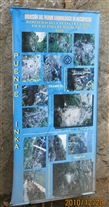
This was a poster or sign giving information about the trail, the gap in it, and the bridge.
I had to sign in and out of the section of the trail approaching the ledge/bridge/etc. I'm not sure where you would end up if you crossed the bridge and went beyond it.
Shutter Speed : 1/79.34
Date Time : 2010:12:20 11:03:22
Equip Model : Canon PowerShot A495
ISO Speed : ISO-80
Focal Length : 9.84
Exposure Time : 0.01
Aperture : F/3.51
IMG_1183.jpg
Machu Picchu
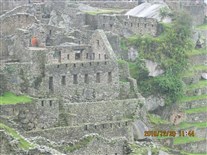
Looks like a shot of the city from up near the Gate House with the 3X zoom on my camera. Note the several stone staircases visible in this shot.
At the location where I took this photo, was partway up the peak on the south side of the city of Machu Picchu. That peak is also called Machu Picchu.
Shutter Speed : 1/125.37
Date Time : 2010:12:20 11:44:33
Equip Model : Canon PowerShot A495
ISO Speed : ISO-100
Focal Length : 21.6
Exposure Time : 0.01
Aperture : F/5.78
IMG_1185.jpg
Machu Picchu
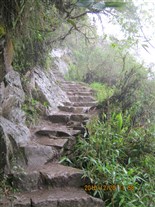
I believe these two photos (which are not shown here in the exact sequence they were taken) were both taken after I had crossed to the north side of the city (a second time) and had started up Huayna Picchu. I'm pretty sure these both show various portions of the trail up that mountain (after had gone down into the gorge mentioned previously, and then started upward).
It's called a trail, but really it's more like a series of steep stone staircases, one after the other.
My memory is the guidebook (or maybe information I'd seen near the entrance to the archeological area) said they only allow 400 people a day onto this trail, with the last entry about 1 pm (may not remember the time correctly). I had timed things to get there perhaps 20-30 minutes before the cutoff time (whatever it was). I wasn't sure I would be allowed onto the trail, but I figured there was a good chance they would not be oversubscribed, since the archeological area had not seemed too crowded in the morning (and the weather was not great, and there did not seem to be a large proportions of younger people -- the prime mountain-hiking age) among the visitors. Turned out I signed the log book as #318 for the day. When I got back and signed the register book to indicate I was exiting the area, I believe they had something like 350 signatures in the book for the day.
Shutter Speed : 1/125.37
Date Time : 2010:12:20 11:58:53
Equip Model : Canon PowerShot A495
ISO Speed : ISO-160
Focal Length : 6.6
Exposure Time : 0.01
Aperture : F/2.99
IMG_1188.jpg
Machu Picchu
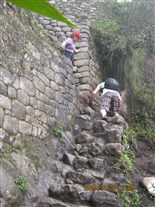
Note the stone retaining walls. Apparently all of this dates from Inca times. However, I suspect the Peru national park service has to do some maintenance on this. It's VERY steep and I'd think between the weather and ~400 hikers a day, stones would occasionally work loose.
The trail takes a left trun (thru the retaining wall) at about where the two people ahead of me are in this photo.
As I said in connection with an earlier photo, the time in Cuzco made for a pretty effective altitude adjustment. I stopped to get my breathing down to roughly normal perhaps every 100 feet of vertical climb on this trek (and I didn't really need my jacket for most of the way up), but it wasn't too bad.
Shutter Speed : 1/101.13
Date Time : 2010:12:20 12:40:51
Equip Model : Canon PowerShot A495
ISO Speed : ISO-80
Focal Length : 6.6
Exposure Time : 0.01
Aperture : F/2.99

IMG_1190.jpg
Machu Picchu
Based on where this photo appears in the sequence, I'm guessing it was somewhere near the beginning of the series of staircases. There had been a second sign that I guess I did not photograph. It was at a fork in the trail, where you had to choose between going to Big or Little Huayna Picchu.
It was pretty clear to me at this point (based partly on how far DOWN I'd gone into that gorge) that I wasn't going to be able to go to both places. I chose the big one.
What I've been calling Huayna Picchu (from a Wikipedia spelling) and the word on the sign are two different spellings of the same place.
Not sure about the coordinates on that sign. They don't look like latitude and longitude.
Shutter Speed : 1/202.25
Date Time : 2010:12:20 12:55:11
Equip Model : Canon PowerShot A495
ISO Speed : ISO-125
Focal Length : 6.6
Exposure Time : 0
Aperture : F/2.99
IMG_1187.jpg
Machu Picchu
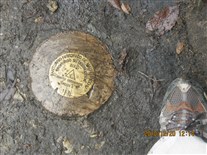
This is out of sequence, but was probably someplace near that sign. It's a geological survey mark of some kind.
Shutter Speed : 1/158.68
Date Time : 2010:12:20 12:14:53
Equip Model : Canon PowerShot A495
ISO Speed : ISO-125
Focal Length : 12.05
Exposure Time : 0.01
Aperture : F/4
IMG_1193.jpg
Machu Picchu
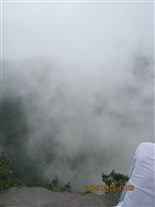
I think this was taken at the top (or near the top) looking back down onto the city (the ruins of the city of Machu Picchu). I had been WAY up into the clouds for the last 1/2 (or thereabouts) of the hike up, and it was pretty clear the view and any photos were going to be disappointing.
Shutter Speed : 1/1243.34
Date Time : 2010:12:20 13:03:38
Equip Model : Canon PowerShot A495
ISO Speed : ISO-100
Focal Length : 6.6
Exposure Time : 0
Aperture : F/2.99
IMG_1201.jpg
Machu Picchu
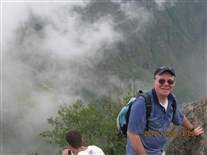
Someone took my photo from the top. I believe the city is below the group of clouds on the left side of the photo.
The guidebook I'd seen suggested a physically fit person could get to the top in one hour, from the sign-in point at the beginning of the trail. It took me 62 minutes to get to the top. The expression "physically fit" is my wording. I forget exactly how they phrased it, but it was something along those lines. I suspect that were saying that if you weren't within sight of the top in a hour, you should turn back.
Shutter Speed : 1/404.5
Date Time : 2010:12:20 13:05:45
Equip Model : Canon PowerShot A495
ISO Speed : ISO-80
Focal Length : 9.84
Exposure Time : 0
Aperture : F/3.51
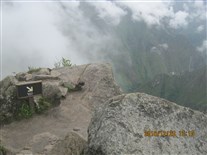
IMG_1205.jpg
Machu Picchu
Arrow points the only place to go from here.
Shutter Speed : 1/1002.93
Date Time : 2010:12:20 13:10:13
Equip Model : Canon PowerShot A495
ISO Speed : ISO-160
Focal Length : 6.6
Exposure Time : 0
Aperture : F/2.99

IMG_1210.jpg
Machu Picchu
There are buildings (temples?) up here too.
Shutter Speed : 1/1002.93
Date Time : 2010:12:20 13:14:21
Equip Model : Canon PowerShot A495
ISO Speed : ISO-160
Focal Length : 6.6
Exposure Time : 0
Aperture : F/2.99

800px-Wayna_Picchu__Peru-27Oct2009.jpg
Huayna Picchu Peru
This is a photo of the top of Huayna Picchu that I got from the internet. It was taken on a much clearer day than the day I was there (and probably with a much better camera and lens than I will even own).
As you can see, even the top of this peak is dense with terraces and structures. The building on the left is the one that shows up in the previous photo. Part of the trail they want you to take going down is on a series of stone staircases that run along the right-hand edge of the stack of terraces on the left side of the photo. I'm not sure those stone stairs are visible in this photo, unless you know what to look for.
I believe the trail they direct you towards while going up runs across one of the terraces in the center (going left to right) and thru the structures in the upper center portion of the photo, just below the peak. These split, "one-way" trails exist only near the very top of the mountain (possibly because the trails are so steep and narrow there). Most of the way, there is only one trail with two-way traffic on it. The split in the trail is someplace near the bottom of the stack of terraces on the left hand side.
The peak itself is a jumble of large boulders. There seem to be two or three people standing there in this photo. However, again, they may be hard to spot unless you been there and know where to look.
I found this photo after returning home from the trip. I'm not sure if I would have been hesitant about going up here or if I would have been more excited about going if I'd seen it prior to the trip. Also, after looking at how steep things look in this photo, I wonder if going up in on a cloudy day (with clouds BELOW me, in addition to above me) made it less scary than it would have been on a clear day.
The original caption of this photo called the peak Wayna Picchu. The photo is dated 27 Oct 2009
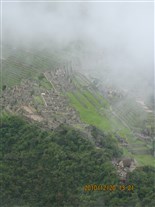
IMG_1214.jpg
Machu Picchu
This photo is the first of six that were taken on the way down. Partway down, I sort of "came thru" the bottom of the cloud layer and was able to get some (low quality) photos of the ruins from this side
Shutter Speed : 1/250.73
Date Time : 2010:12:20 13:21:54
Equip Model : Canon PowerShot A495
ISO Speed : ISO-80
Focal Length : 21.6
Exposure Time : 0
Aperture : F/5.78
IMG_1217.jpg
Machu Picchu
Again, just a smidign of the city was visible thru the clouds from up here near thesummit on this day.
Shutter Speed : 1/1002.93
Date Time : 2013:02:26 14:55:35
Equip Model : Canon PowerShot A495
ISO Speed : ISO-160
Focal Length : 6.6
Exposure Time : 0
Aperture : F/2.99

IMG_1218.jpg
Machu Picchu
A bit lower down. Some of the city became visible.
Shutter Speed : 1/125.37
Date Time : 2010:12:20 13:24:50
Equip Model : Canon PowerShot A495
ISO Speed : ISO-80
Focal Length : 21.6
Exposure Time : 0.01
Aperture : F/5.78
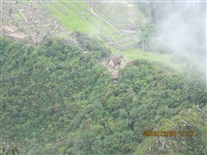
IMG_1221.jpg
Machu Picchu
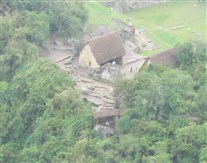
This is the north end of the archelogical area. The rectangular grassy area is what I had called a ceremonial area in some of the descriptions of photos taken in the morning. Here it is viewed from the other side.
The building with a thatched roof seemed to mostly be a shelter for rain (and possibly for where park rangers give talks at times?). There are actually two roofed buildings facing each other, but the second one is difficult to see in this photo).The next photo is a close-up of these areas, probably taken with the 3X zoom.
Shutter Speed : 1/125.37
Date Time : 2010:12:20 13:27:05
Equip Model : Canon PowerShot A495
ISO Speed : ISO-80
Focal Length : 21.6
Exposure Time : 0.01
Aperture : F/5.78
IMG_1221A.jpg
Machu Picchu
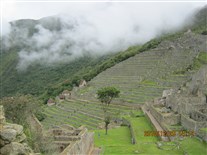
There is a small thatched-roofed seating area near the bottom certer of this photo. There appears to be a person with light-colored pants sitting on a bench in that little shelter. The sign-in booth for this trail is near that small shelter (probably hidden by the greenery to the right of the shelter).
The beginning of the dropoff into the gorge is visible in the lower left section of this photo. That is the top rim of the gorge.
Shutter Speed : 1/125.37
Date Time : 2010:12:20 13:27:05
Equip Model : Canon PowerShot A495
ISO Speed : ISO-80
Focal Length : 21.6
Exposure Time : 0.01
Aperture : F/5.78

IMG_1225.jpg
Machu Picchu
Someone took my photo on a terrace partway down from the summit (and just slightly off the main trail). My memory is that this was a guy from Austraila who had a wife and about 3 teenage children with him.
A bit of the ruins are visible, far below, near my left arm.
Shutter Speed : 1/1002.93
Date Time : 2010:12:20 13:28:33
Equip Model : Canon PowerShot A495
ISO Speed : ISO-125
Focal Length : 8.06
Exposure Time : 0
Aperture : F/3.18
IMG_1236.jpg
Machu Picchu
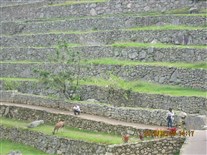
I'm back down in the archeological area now. This is a wide-angle view of the terrace area where we entered the city in the morning. The initial entrance was in the thatched-roor buiidings on the left. The Gate House is at the top.
Shutter Speed : 1/809
Date Time : 2010:12:20 14:12:25
Equip Model : Canon PowerShot A495
ISO Speed : ISO-160
Focal Length : 6.6
Exposure Time : 0
Aperture : F/2.99
IMG_1239.jpg
Ollantaytambo
At least one llama had moved over to this terraced area by the time I got down from the peak.
Worked up a pretty good appitite on this trek. That night we ate in Aguas Calentes (which has several tourist restaurants -- but not expensive ones). I believe this was the first night I ate alpaca meat (which is outstanding). If the eat llamas, I don't remember it.
Shutter Speed : 1/125.37
Date Time : 2010:12:20 14:17:20
Equip Model : Canon PowerShot A495
ISO Speed : ISO-80
Focal Length : 21.6
Exposure Time : 0.01
Aperture : F/5.78

614px-80_-_Machu_Picchu_-_Juin_2009_-_edit_2.jpg
Machu Pichu (Photo From Internet)
This is another photo I got off the internet, to show what the place looks like on a sunny day. This is taken facing north. I seems to be taken from a point higher up toward Machu Picchu mountain that I ever got to.

IMG_1258.jpg
Ollantaytambo
This is the next day, after we had taken a train to Ollantaytambo. This was perhaps 5 or 6 stations "up" from where we boarded the train in Aguas Calentes that morning. Most of the trail guides and porters who had been "working with Inca Trail hikers) also got off here.
It was interesting to see that many were carrying very large loads in poorly-made backpacks,with crude shoulder straps (and no belt provisions for transfering the weigh of the pack onto the hips -- some were not even backpacks at all; what some had were more like duffle bags, with no shoulder straps.
Apparently, when you pay to go on an "organized" 4-day hike of the Inca Trail, you only have to carry your clothes, a canteen, and (maybe) a sandwiich for your lunch on a given day. The porters carry the tents, food, cooking equipment, etc. I think they also go ahead and have tents set up and food cooked when you get to the campsite for each night..
Shutter Speed : 1/501.46
Date Time : 2010:12:21 07:45:12
Equip Model : Canon PowerShot A495
ISO Speed : ISO-320
Focal Length : 14.8
Exposure Time : 0
Aperture : F/4.5
IMG_1259.jpg
Ollantaytambo
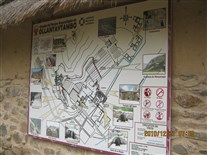
Map of the ruins here.
Shutter Speed : 1/501.46
Date Time : 2010:12:21 07:50:20
Equip Model : Canon PowerShot A495
ISO Speed : ISO-100
Focal Length : 6.6
Exposure Time : 0
Aperture : F/2.99
IMG_1260.jpg
Ollantaytambo
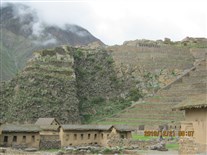
Again, terraces. The sturctures at top left are pre-Inca, if I recall correctly.
Shutter Speed : 1/404.5
Date Time : 2010:12:21 08:07:10
Equip Model : Canon PowerShot A495
ISO Speed : ISO-160
Focal Length : 9.84
Exposure Time : 0
Aperture : F/3.51
IMG_1261.jpg
Ollantaytambo
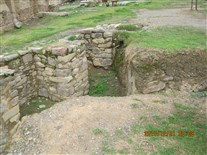
This was down on the valley floor, before we started up. I don't remember the story exactly, but apparently there had been a flood or a landslide here (some time after the Spanish conquest). The current ground level of the valley floor is several feet above where it was in Inca times. They have excavated down to the walls of the original buildings (the story was SOMETHING along those lines).
Shutter Speed : 1/317.37
Date Time : 2010:12:21 08:08:26
Equip Model : Canon PowerShot A495
ISO Speed : ISO-80
Focal Length : 6.6
Exposure Time : 0
Aperture : F/2.99
IMG_1263.jpg
Ollantaytambo
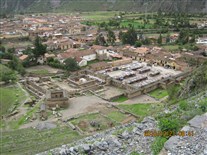
Taken after climbing up to the top of the terraces. I believe that is the archeological area in the center of the photo. The below-grade trenches are into the Inca time, The on-grade structures and stones are from early colonial times, I think.
Shutter Speed : 1/317.37
Date Time : 2010:12:21 08:41:56
Equip Model : Canon PowerShot A495
ISO Speed : ISO-80
Focal Length : 6.6
Exposure Time : 0
Aperture : F/2.99

IMG_1266.jpg
Ollantaytambo
Shutter Speed : 1/125.37
Date Time : 2010:12:21 08:42:55
Equip Model : Canon PowerShot A495
ISO Speed : ISO-80
Focal Length : 21.6
Exposure Time : 0.01
Aperture : F/5.78

IMG_1266A.jpg
Ollantaytambo
Two women waiting for Inca Bucks to open.
Shutter Speed : 1/125.37
Date Time : 2010:12:21 08:42:55
Equip Model : Canon PowerShot A495
ISO Speed : ISO-80
Focal Length : 21.6
Exposure Time : 0.01
Aperture : F/5.78

IMG_1269.jpg
Ollantaytambo
This is a temple at the top. Interesting thing is that it was never finished. It was under construction at the time of the conquest (and, of course, after the conquest, the church would not permit pagan temples to be built). Several large stone blocks are around, not yet smoothed off and/or put into place.
Shutter Speed : 1/1002.93
Date Time : 2013:02:26 17:25:59
Equip Model : Canon PowerShot A495
ISO Speed : ISO-80
Focal Length : 8.06
Exposure Time : 0
Aperture : F/5.03
IMG_1270.jpg
Ollantaytambo
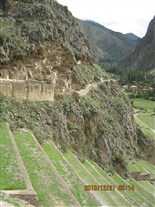
We had come on the pathway along the face of the bluff (which did not look as narrow at the time as it does in this photo).
Shutter Speed : 1/634.73
Date Time : 2013:02:26 15:29:00
Equip Model : Canon PowerShot A495
ISO Speed : ISO-80
Focal Length : 6.6
Exposure Time : 0
Aperture : F/2.99
IMG_1274.jpg
Ollantaytambo
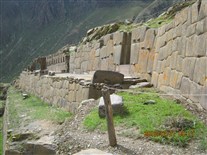
Again, some of the nice stonework, where the stones are precisely shaped to fit into one another, with no mortar.
If I recall correctly, the story on the "knobs" sticking out from some of them is related to this temple being unfinished. I think the story was that those "knobs" were used (in some way) to handle, move, and position the large stones. Then, when the stone was in it's final position, the surface would be ground down or polished to remove the "knob". The work on this temple was interrupted before they had finished grinding off all these knobs.
The not-yet-finished aspect of this temple may also be related to what may be similar "knobs" in the large vertical stone slabs shown two images previously.
Shutter Speed : 1/809
Date Time : 2010:12:21 09:17:43
Equip Model : Canon PowerShot A495
ISO Speed : ISO-80
Focal Length : 6.6
Exposure Time : 0
Aperture : F/2.99
IMG_1279.jpg
Sacred Valley
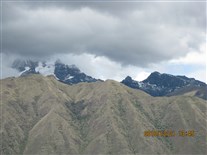
This was later in the day, on the way back to Cuzco -- and probably taken from a moving vehicle. I think I was mostly trying to photograph the snow on the not-too-distant mountains, and also the clouds.
Shutter Speed : 1/317.37
Date Time : 2010:12:21 13:45:33
Equip Model : Canon PowerShot A495
ISO Speed : ISO-80
Focal Length : 21.6
Exposure Time : 0
Aperture : F/5.78
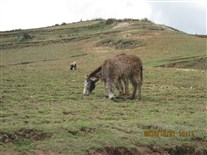
IMG_1292.jpg
Sacred Valley
Donkeys -- and a goat in the background, I think.
Shutter Speed : 1/202.25
Date Time : 2010:12:21 14:11:43
Equip Model : Canon PowerShot A495
ISO Speed : ISO-80
Focal Length : 21.6
Exposure Time : 0
Aperture : F/5.78

IMG_1301.jpg
Sacred Valley
This was a "shopping" stop (picked by the tour guide) where they gave a demonstration of dyeing and weaving at a small semi-outdoor shop. This is basically a salesgirl, in costume. This is one of several places where we ran into an odd thing: they would not take our US money (or credit cards). Apparently the banks outside Lima will only exchange US bills that are in perfect conditons (no permanent folds or small tears on the edges). Because of this, merchants will not take them either. They call it "broken" money.
Shutter Speed : 1/125.37
Date Time : 2010:12:21 14:24:20
Equip Model : Canon PowerShot A495
ISO Speed : ISO-200
Focal Length : 21.6
Exposure Time : 0.01
Aperture : F/5.78
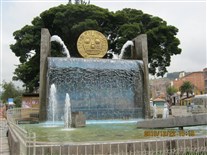
IMG_1302.jpg
Cuzco
This was a fountain near our hotel in Cuzco. The disk is a replica of an Inca symbol of some kind. If my memory is correct, you can walk behind the waterfall and look thru the falling water.
Shutter Speed : 1/809
Date Time : 2010:12:22 10:19:39
Equip Model : Canon PowerShot A495
ISO Speed : ISO-160
Focal Length : 6.6
Exposure Time : 0
Aperture : F/4.5
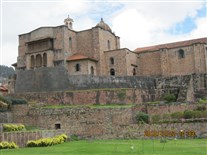
IMG_1304.jpg
Cuzco
I think this is the exterior of a building we had toured parts of the first day in Cuzco -- a convent, I think.
Shutter Speed : 1/1002.93
Date Time : 2010:12:22 10:33:03
Equip Model : Canon PowerShot A495
ISO Speed : ISO-160
Focal Length : 9.84
Exposure Time : 0
Aperture : F/3.51
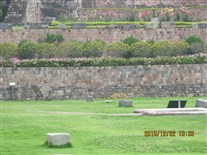
IMG_1306.jpg
Cuzco
Shutter Speed : 1/501.46
Date Time : 2010:12:22 10:33:24
Equip Model : Canon PowerShot A495
ISO Speed : ISO-250
Focal Length : 21.6
Exposure Time : 0
Aperture : F/5.78

IMG_1312.jpg
Cuzco
A creche set up in the central square for Christmas.
Shutter Speed : 1/1002.93
Date Time : 2010:12:22 11:09:12
Equip Model : Canon PowerShot A495
ISO Speed : ISO-160
Focal Length : 6.6
Exposure Time : 0
Aperture : F/2.99
IMG_1314.jpg
Cuzco
Another part of the creche.
There had also been a large creche in the lobby of the hotel in Aguas Calentes, which had some odd (burt interesting things in it -- such as a small figure of a frog and two or three of dinosaurs. Apparently I didn't get a good enough photo of it to include one in this album.
Shutter Speed : 1/250.73
Date Time : 2010:12:22 11:09:36
Equip Model : Canon PowerShot A495
ISO Speed : ISO-160
Focal Length : 14.8
Exposure Time : 0
Aperture : F/4.5

IMG_1316.jpg
Cuzco
The first day in Cuzco (which was a Sunday, I believe) we had seen several cute-as-could-be little girls in their traditional dress and carrying lambs or baby goats.
The pose for photos, but you really need a coin to give them as a tip. Oddly, it's rather difficult to get coins in Peru (in the Peruvian currency, the sol, which is really the Nuevo Sol, they have probably revalued at least once over the years).
Finally, the last full day in Cuzco, I had managed to hoard a few coins and I picked a girl (ONE girl, was my intention). She immediately called out to a bunch of friends, who came running. I ended up having to snap one this one quick photo, before more of them showed up than I had coins for (I had visions of creating an international incident).
This one photo was just snapped quickly -- not carefully posed and focused as I had planned.
During the trip, saw several mature women (mid-30s and up) wearing more traditional clothing (including hats somewhere between a fedora and a stovepipe). The women dressed this way were mostly out in the countryside, as best I recall (not in Cuzco).
Shutter Speed : 1/501.46
Date Time : 2010:12:22 11:25:50
Equip Model : Canon PowerShot A495
ISO Speed : ISO-125
Focal Length : 6.6
Exposure Time : 0
Aperture : F/2.99

IMG_1319.jpg
Cuzco
This is a mural one the side of a building that was close to a block long. Again, a sun-shaped Inca symbol shows up (but the details on this one are different from the one a few photos back).
It looked like the enitire history of Peru was on this mural. I think on this part we have the Inca king on the left and the Spanish conquerors (on horseback) on the right.
Shutter Speed : 1/404.5
Date Time : 2010:12:22 12:08:17
Equip Model : Canon PowerShot A495
ISO Speed : ISO-80
Focal Length : 9.84
Exposure Time : 0
Aperture : F/3.51

IMG_1321A.jpg
Cuzco
Same mural. This is the end, where (I guess) everyone lives happily ever after -- top right).
Across the street from this mural (behind where I was standing when I took thes photos) were businesses, largely travel agencies and banks. There would be three or four ladies standing quietly in front of the entrance to each bank, each holdiing a wad of currency (US currency in at least some cases). They did not seem to be bank employees. They were clearly there waiting for people to come up to them to make some kind of transaction (without going into the bank) -- possibly an off-the-books transaction or underground economy transaction. I never found out was was going on there.
Shutter Speed : 1/1002.93
Date Time : 2010:12:22 12:08:29
Equip Model : Canon PowerShot A495
ISO Speed : ISO-160
Focal Length : 9.84
Exposure Time : 0
Aperture : F/3.51

IMG_1327.jpg
Cuzco
Murals inside the hotel. I believe this was in the lobby.
Shutter Speed : 1/50.56
Date Time : 2010:12:22 17:35:24
Equip Model : Canon PowerShot A495
ISO Speed : ISO-640
Focal Length : 6.6
Exposure Time : 0.02
Aperture : F/2.99

IMG_1328.jpg
Cuzco
Murals inside the hotel. I believe this was in their breakfast room upon the sixth floor.
Shutter Speed : 1/50.56
Date Time : 2010:12:22 17:36:02
Equip Model : Canon PowerShot A495
ISO Speed : ISO-640
Focal Length : 6.6
Exposure Time : 0.02
Aperture : F/2.99

IMG_1342.jpg
Paul and Joanna Soper
I think this is in the Cuzco airport, during a long delay waiting for fog to lift, if I recall correctly.
Shutter Speed : 1/19.84
Date Time : 2010:12:23 10:31:56
Equip Model : Canon PowerShot A495
ISO Speed : ISO-640
Focal Length : 6.6
Exposure Time : 0.05
Aperture : F/2.99
